
Countertop Installation in Helena, MT
Nothing in a kitchen gets touched more than the counters. They take hot pans, cutting boards, spilled coffee, and homework spread out after school. Rodriguez Painting provides countertop installation in Helena, MT, setting granite and marble tops in kitchens and bathrooms. You get a work surface that holds up to daily use and looks good doing it.

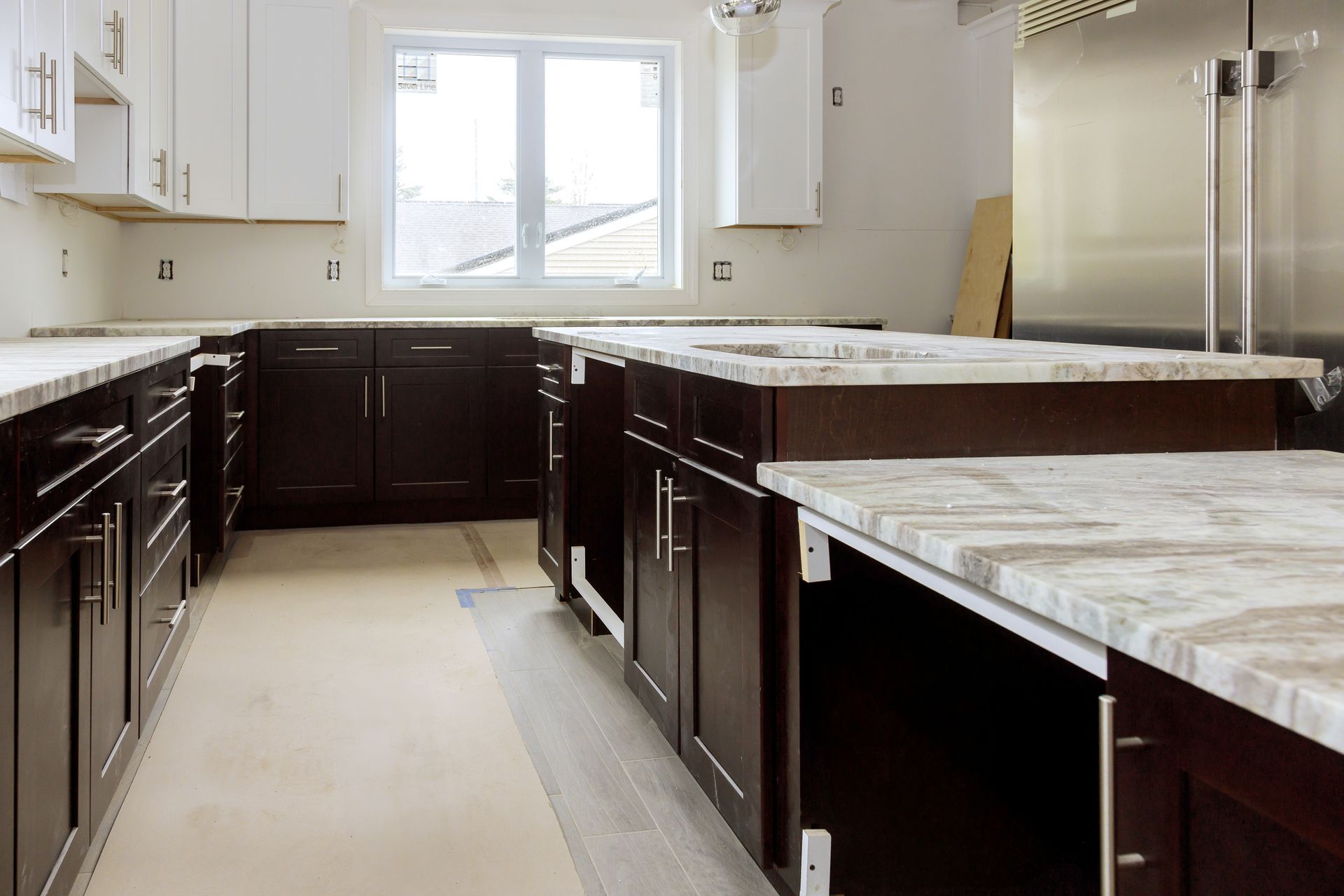
Which Is Better for a Kitchen, Granite or Marble?
Granite is usually the better choice for a busy kitchen because it is harder than marble and resists etching from acidic foods. Marble is softer and reacts to lemon juice, vinegar, tomato sauce, and wine, which leave dull marks on the surface. Many homeowners still choose marble for its look and accept the wear as it ages. Others put it on an island or a baking station and use granite where the heavy prep happens.
Kitchens and bathrooms see more steam and scrubbing than other rooms. A repaint gives them a fresh look and a finish that holds up to that use. Bathrooms in particular benefit from a finish that stands up to daily humidity. It's one of the quickest ways to change how a room feels without a remodel.
Granite and Marble Countertops
Both stones are natural, so no two slabs look exactly alike. The differences come down to durability, care, and the look you want.
Granite Countertops
Granite forms from cooled magma, which makes it dense and hard. It resists scratches from everyday use and handles heat well. It comes in a wide range of colors, from nearly solid black to busy patterns with flecks of gold, gray, and white. Once sealed, it shrugs off most kitchen spills.
Marble Countertops
Marble is metamorphic stone with soft veining that many people associate with classic kitchens and bathrooms. It stays cool to the touch, which bakers like for rolling dough. It needs more care than granite, and it tends to develop a softer, lived-in surface over time.
Stone Countertops in Bathrooms
Bathroom vanities see less abuse than kitchen counters, which makes them a good place for marble. Toothpaste and some cleaners can still etch it, so wiping up promptly matters here too.
Renovations Around Helena
Most renovation work happens in Helena itself, with projects in East Helena, Boulder, and Townsend as well. If your home is outside those towns, a quick call will confirm whether it is within range. For everything else the business offers, visit the Rodriguez Painting home page.
How Countertop Installation Works
Stone tops are cut to fit your cabinets exactly, so the process starts with measurements and ends with a final fit on site:
- Template. Once the cabinets are level and secure, a template is made of the exact shape, including corners, overhangs, and openings for the sink and cooktop.
- Cutting. The slab is cut to that template.
- Setting. The tops are set, leveled, and fastened to the cabinets.
- Seams and sealing. Seams are joined and color-matched, and the stone is sealed.
Countertops are often the centerpiece of larger kitchen remodeling. They pair well with refinished cabinets and a new backsplash. When the existing tops are still in good shape, refinishing may be enough without new stone.
Keeping Stone Looking New
Stone lasts for decades with simple care. Wipe spills promptly, use cutting boards, and clean with pH-neutral products made for stone. Marble that has dulled from years of use can be restored through concrete and marble polishing, which brings the shine back without replacing the slab.
Countertops Around Helena
Countertop projects come from across Helena as well as Boulder and Townsend. When you call, a rough sketch of your counter layout with measurements helps start the conversation. To see everything else Rodriguez Paintingoffers, visit the home page.
Drywall, From Small Holes to Full Rooms
Damaged walls show through any paint. A doorknob hole, a water stain, or a crack running out from a window corner all need fixing first. Drywall repair patches those spots so the wall reads as one smooth surface again. Some projects need new walls: a basement being finished, a wall being moved, a room being opened up. Drywall installation takes those from bare studs to a surface ready for paint. The work includes tape and bed on every seam and texture matched to the rest of the house, so new sections blend with the old. The same business hangs, finishes, and paints the drywall. There is no handoff between trades, and no question about who owns a seam that shows.
Countertop Installation FAQ
How thick should stone countertops be?
The two standard thicknesses are 2 cm (about 3/4 inch) and 3 cm (about 1 1/4 inches). Kitchens commonly use 3 cm stone, which is strong enough to sit directly on the cabinets. Thinner 2 cm stone usually needs a plywood base underneath and is more common on bathroom vanities.
Can my cabinets support granite?
A 3 cm granite countertop weighs about 18 to 20 pounds per square foot. Standard base cabinets that are level, solid, and securely fastened can usually carry that weight. Cabinets with water damage or loose joints should be repaired or reinforced before stone goes on top.
How high should a kitchen backsplash go?
The standard backsplash covers the wall between the countertop and the upper cabinets, usually about 18 inches. Behind a range with no upper cabinet, many homeowners run the tile up to the hood or the ceiling. That creates a focal point and protects the wall from grease splatter.
Will my countertop have seams?
Most slabs run about 9 to 10 feet long. A straight run longer than that, or an L-shaped layout, usually needs at least one seam. Seams are placed away from sinks and high-stress areas where possible. They are filled with tinted epoxy so they blend into the stone.
How long does countertop installation take?
The full process from template to finished install commonly takes 1 to 3 weeks, depending on slab availability and cutting schedules. Installation day itself is usually a few hours for a typical kitchen. Plumbing reconnection for the sink follows once the tops are set.
How often do granite and marble need to be sealed?
Granite typically needs resealing every 1 to 2 years. Marble needs it more often, about every 6 to 12 months. To test, drip water on the surface. If the stone darkens within a few minutes instead of the water beading up, it is time to reseal.